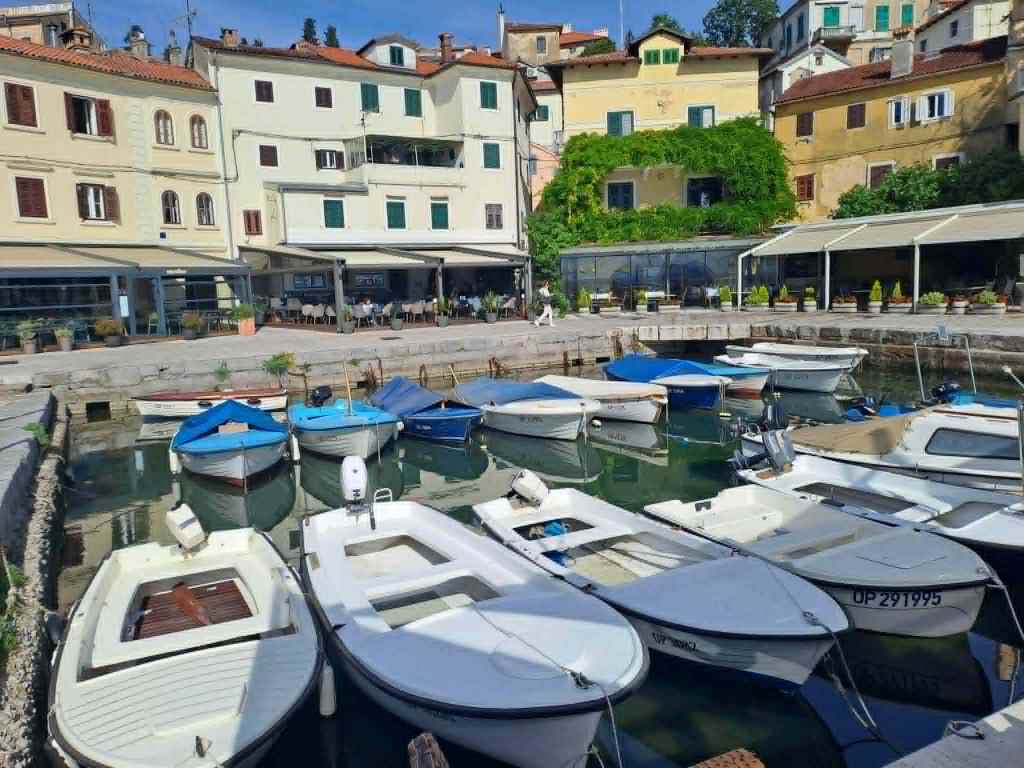
Learning a few useful Croatian phrases can completely change the way you experience Croatia.
Even if you are only beginning to learn Croatian, knowing how to greet someone, order a coffee, ask for help or explain that you do not understand can make everyday situations easier and more enjoyable.
You do not need to master Croatian grammar before you start speaking.
In fact, learning complete phrases is often one of the most effective ways to begin. Instead of memorising isolated words, you learn how Croatian is naturally used in real conversations.
This guide includes 50 essential Croatian phrases for beginners, organised by situation. You can use them while travelling, living in Croatia, meeting Croatian family members or simply taking your first steps in the language.
Basic Croatian Greetings
Greetings are the easiest way to begin using Croatian in everyday life.
1. Dobar dan.
Good afternoon. / Hello.
This is the safest and most useful formal greeting. You can use it in shops, offices, restaurants and when speaking to someone you do not know well.
2. Dobro jutro.
Good morning.
Use this greeting during the morning.
3. Dobra večer.
Good evening.
Use it when greeting someone in the evening.
4. Bok.
Hi. / Bye.
Bok is informal and very common. It can be used both when meeting someone and when leaving.
5. Pozdrav.
Hello. / Greetings.
This can be used as a friendly greeting or sign-off.
6. Kako ste?
How are you?
This is the formal or plural version.
7. Kako si?
How are you?
This is the informal singular version, used with friends, family and people you know well.
8. Dobro sam, hvala.
I’m fine, thank you.
9. Drago mi je.
Nice to meet you.
10. Vidimo se.
See you.
This literally means “We’ll see each other.”
Polite Croatian Phrases
Politeness is important in Croatian, especially in formal situations.
11. Molim.
Please. / You’re welcome.
The meaning depends on the context.
12. Hvala.
Thank you.
13. Hvala lijepa.
Thank you very much.
14. Nema na čemu.
You’re welcome.
15. Oprostite.
Excuse me. / Sorry.
Use this when asking a stranger a question, getting someone’s attention or apologising.
16. Žao mi je.
I’m sorry.
17. Izvolite.
Here you are. / Go ahead.
You may hear this in shops, restaurants and offices.
18. Možete li mi pomoći?
Can you help me?
19. Možete li ponoviti?
Can you repeat that?
20. Možete li govoriti sporije?
Can you speak more slowly?
Croatian Phrases for Beginners Who Are Still Learning
These phrases are especially useful when a conversation becomes difficult.
21. Učim hrvatski.
I am learning Croatian.
22. Govorim malo hrvatski.
I speak a little Croatian.
23. Ne govorim dobro hrvatski.
I do not speak Croatian well.
24. Ne razumijem.
I do not understand.
25. Razumijem.
I understand.
26. Kako se kaže…?
How do you say…?
27. Što to znači?
What does that mean?
28. Kako se ovo izgovara?
How is this pronounced?
29. Možete li to napisati?
Can you write that down?
30. Jesam li dobro rekla?
Did I say it correctly?
A man would say:
Jesam li dobro rekao?
Croatian Phrases for Cafés and Restaurants
Food and drink are among the easiest situations in which to practise Croatian.
31. Jednu kavu, molim.
One coffee, please.
32. Jednu vodu, molim.
One water, please.
33. Molim vas jelovnik.
The menu, please.
34. Što preporučujete?
What do you recommend?
35. Ja ću…
I’ll have…
For example:
Ja ću ribu.
I’ll have the fish.
36. Bez šećera, molim.
Without sugar, please.
37. Bez leda, molim.
Without ice, please.
38. Račun, molim.
The bill, please.
39. Mogu li platiti karticom?
Can I pay by card?
40. Bilo je jako ukusno.
It was very delicious.
A more natural English translation would be:
It was very tasty.
Croatian Phrases for Shopping
These basic Croatian phrases can help you in shops, markets and pharmacies.
41. Koliko košta?
How much does it cost?
42. Imate li ovo u drugoj veličini?
Do you have this in another size?
43. Imate li nešto jeftinije?
Do you have something cheaper?
44. Samo gledam, hvala.
I’m just looking, thank you.
45. Uzet ću ovo.
I’ll take this.
46. Gdje je blagajna?
Where is the checkout?
47. Trebam vrećicu.
I need a bag.
48. Ne trebam vrećicu.
I do not need a bag.
49. Mogu li dobiti račun?
Can I have a receipt?
50. Imate li sitno?
Do you have change?
Useful Croatian Phrases for Asking Directions
When travelling or living in Croatia, you will often need to ask where something is.
A useful general phrase is:
Gdje je…?
This means:
Where is…?
For example:
Gdje je kolodvor?
Where is the station?
Gdje je autobusna stanica?
Where is the bus stop?
Gdje je centar grada?
Where is the city centre?
Gdje je najbliža ljekarna?
Where is the nearest pharmacy?
You can also ask:
Kako mogu doći do centra?
How can I get to the city centre?
Another useful phrase is:
Je li daleko?
Is it far?
Croatian Phrases for Everyday Problems
These phrases can help when something goes wrong.
Trebam pomoć.
I need help.
Izgubio sam novčanik.
I have lost my wallet.
A woman would say:
Izgubila sam novčanik.
Ne osjećam se dobro.
I do not feel well.
Trebam liječnika.
I need a doctor.
Gdje je policijska postaja?
Where is the police station?
Moj telefon ne radi.
My phone is not working.
Imam problem.
I have a problem.
Možete li nazvati taksi?
Can you call a taxi?
Common Croatian Responses
Understanding short replies can be just as important as knowing what to say.
Da.
Yes.
Ne.
No.
Možda.
Maybe.
Naravno.
Of course.
U redu.
All right.
Dobro.
Good. / Okay.
Nema problema.
No problem.
Ne znam.
I do not know.
Mislim da da.
I think so.
Mislim da ne.
I do not think so.
Formal and Informal Croatian
Croatian distinguishes between formal and informal forms of “you.”
Use ti with friends, family members, children and people you know well.
Use Vi with strangers, clients, older people and in formal situations.
For example:
Kako si?
How are you?
This is informal.
Kako ste?
How are you?
This is formal or plural.
The same distinction appears in requests.
Možeš li mi pomoći?
Can you help me?
This is informal.
Možete li mi pomoći?
Can you help me?
This is formal.
When you are unsure which form to use, begin with the formal version. It is safer and more polite.
Croatian Pronunciation Tips for Beginners
Croatian spelling is relatively consistent, which means words are generally pronounced as they are written.
Each letter usually represents one sound.
The letter j is pronounced like the English y in yes.
For example:
ja
I
The letter š sounds like sh in shoe.
The letter č is similar to ch in chair.
The letter ž sounds like the sound in the English word vision.
Croatian also includes the letter combinations lj, nj and dž.
Do not worry about sounding perfect immediately. Focus first on speaking clearly and learning the rhythm of useful phrases.
How to Remember Croatian Phrases
Reading a list once is not enough to remember the phrases.
Choose five phrases that match situations you are likely to experience.
Read them aloud several times. Write them down. Use them in a short imaginary conversation.
For example, if you often visit cafés, practise:
Dobar dan.
Jednu kavu, molim.
Bez šećera, molim.
Račun, molim.
Hvala, doviđenja.
When you learn phrases in a realistic sequence, they are easier to remember and use.
You can also create small groups based on your daily routine.
Learn phrases for your local shop, café, workplace, neighbours or Croatian family members.
The more personally relevant the language is, the easier it becomes to remember.
Should You Learn Individual Words or Complete Phrases?
Both are useful, but beginners often benefit more from complete phrases.
An individual word gives you vocabulary.
A complete phrase gives you vocabulary, grammar, pronunciation and context at the same time.
For example, learning the word:
pomoć
means you know the Croatian word for “help.”
Learning:
Možete li mi pomoći?
means you know how to ask for help in a real situation.
Phrase-based learning also reduces the need to translate every sentence word by word.
Over time, you begin to recognise sentence patterns and adapt them.
For example:
Gdje je ljekarna?
Where is the pharmacy?
You can later replace one word:
Gdje je banka?
Where is the bank?
Gdje je hotel?
Where is the hotel?
Gdje je restoran?
Where is the restaurant?
One useful structure can help you create many new sentences.
Can You Learn Croatian Through Phrases Alone?
Learning phrases is an excellent starting point, but phrases alone will not take you to an advanced level.
You will eventually need to understand basic grammar, cases, verb forms and sentence structure.
However, grammar is easier to understand when you already know real examples.
For instance, the phrase:
Pijem kavu.
helps you recognise how the noun kava changes when it becomes the object of a sentence.
Instead of beginning with an abstract grammar table, you begin with language you can actually use.
This is one of the central ideas behind the Calm Croatian approach.
Learn useful language first, notice the patterns and then build your grammar gradually.
Start Speaking Croatian Today
You do not need to memorise all 50 phrases before using Croatian.
Choose a few expressions that are relevant to your life and begin there.
Say Dobar dan when you enter a shop.
Order your coffee in Croatian.
Tell someone Učim hrvatski if the conversation becomes difficult.
Ask Možete li govoriti sporije? when you need more time.
Each small interaction makes the next one easier.
Confidence does not come from waiting until your Croatian is perfect.
It develops through using the Croatian you already know.
Learn More Practical Croatian
The Calm Croatian Phrasebook was created for learners who want useful Croatian for everyday situations.
It includes practical phrases that can help you communicate more confidently while travelling, living in Croatia or speaking with Croatian family and friends.
The Calm Croatian Roadmap is designed for learners who need more structure and want to understand what to study next.
You do not need hundreds of grammar rules to begin.
You need the right phrases, a clear learning plan and regular opportunities to use the language.
YOUR NEXT STEP · PAID PDF EBOOK
Keep useful Croatian close at hand
The Calm Croatian Phrasebook. A 27-page PDF with phrases and English translations for cafés, shops, doctor and pharmacy visits, the post office, neighbours and phone calls, plus emergency phrases.
€19 · Instant PDF download · No subscription · Audio and live lessons are not included.


Leave a Reply